

Redistricting Priorities – Local Government Perspectives on Communities of Interest

Written by: Christopher Collard

Keep an eye out for three more posts looking at “Local Government Perspectives.”  


About the Survey

The Utah Foundation sought to gain a deeper understanding of how local elected officials viewed the redistricting process. We sent out a survey to elected municipal officials (mayors and city council members). This survey was conducted by University of Utah students in collaboration with the Utah Foundation.  There are about 250 cities, and more than 700 mayors and city council members. We received 96 respondents. The survey ran from October 23, 2020, to November 12, 2020.


What is Redistricting?

Redistricting is a process in which the government or a commission subdivides an area into different districts that will vote for their representative. Often, this focus is on state-drawn districts for members of the U.S. House of Representatives, but it also applies to state legislatures and state school board districts. There are several general principles to consider in redistricting. One of the most important things is that each district has the same number of people. Contiguity (where all the parts of a district are connected) and compactness (tighter districts are generally considered better than sprawling ones) are also important considerations. There are several additional priorities, including preserving communities of interest, maintaining geographical or man-made boundaries, keeping the core of prior districts, minimizing the division of municipalities and counties, ensuring that boundaries align at different political levels, and prohibiting the purposeful favoring or disfavoring of a party, incumbent, or candidate.

Preferred Maps

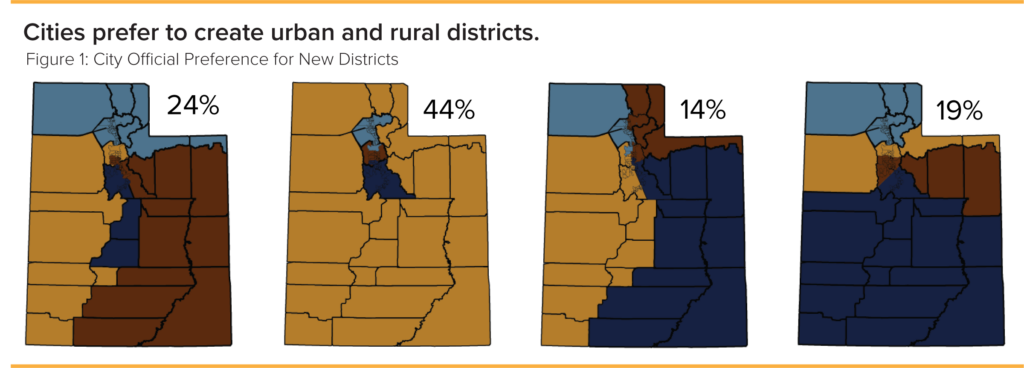
In 2020, the Utah Foundation conducted a survey of city officials to gain insight into their perspectives on redistricting. One question offered a small sample of maps to choose from, asking respondents which redistricting option would most benefit their community. The urban/rural map was most popular, although nearly a quarter of respondents were satisfied with the status quo.  (See Figure 1.)


Question: “If the current congressional district boundaries were to be redrawn, which of the following options would most benefit the community you represent?”


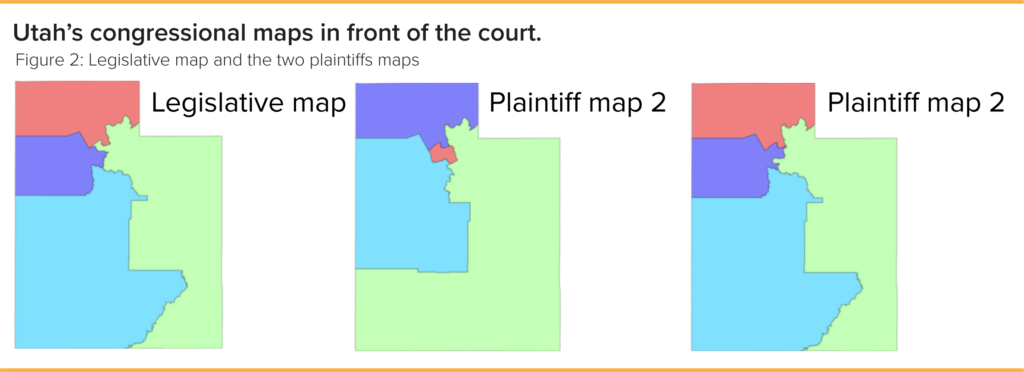
A Utah court required the Legislature to redraw its congressional districts. The Legislature finalized its choice, though Better Boundaries quickly responded with a lawsuit and two maps of their own. (See Figure 2.)  


The court maps are from the Better Utah Institute, “Congressional Map Scores and Analysis,” https://betterutahinstitute.org/maps-report/.


Ultimately, there are numerous ways to draw maps. You can try your own hand at map drawing, here.

See the three other posts looking at “Local Government Perspectives” on the Utah Foundation’s Redistricting in Utah page.


About the Survey

The Utah Foundation sought to gain a deeper understanding of how local elected officials viewed the redistricting process. We sent out a survey to elected municipal officials (mayors and city council members). This survey was conducted by University of Utah students in collaboration with the Utah Foundation.  There are about 250 cities, and more than 700 mayors and city council members. We received 96 respondents. The survey ran from October 23, 2020, to November 12, 2020.


What is Redistricting?

Redistricting is a process in which the government or a commission subdivides an area into different districts that will vote for their representative. Often, this focus is on state-drawn districts for members of the U.S. House of Representatives, but it also applies to state legislatures and state school board districts. There are several general principles to consider in redistricting. One of the most important things is that each district has the same number of people. Contiguity (where all the parts of a district are connected) and compactness (tighter districts are generally considered better than sprawling ones) are also important considerations. There are several additional priorities, including preserving communities of interest, maintaining geographical or man-made boundaries, keeping the core of prior districts, minimizing the division of municipalities and counties, ensuring that boundaries align at different political levels, and prohibiting the purposeful favoring or disfavoring of a party, incumbent, or candidate.

Choosing Communities

In 2020, the Utah Foundation surveyed city officials to understand how they view their communities. One of the priorities of Utah’s redistricting commission was to keep together “communities of interest.” With that in mind, the Utah Foundation sought to better understand how city officials viewed their communities and which communities shared interests. To accomplish this, the Utah Foundation showed respondents a map of the state, asking them to select which four to six cities are most similar to their own.

Most city officials tended to choose nearby communities. This wasn’t always the case. Sometimes, similar communities were in other parts of the state. For example, one community in Iron County (which is in southwestern Utah) selected a community in Wasatch County (which is in north-central Utah). Another Iron County community selected a community in Uintah County (which is in central eastern Utah). A community in Salt Lake County selected a community in Washington County (which is in southwestern Utah).

Overall, officials usually identified with communities in counties that were the same size or smaller than their own. Rarely did an official identify with another community in a county that was substantially larger than their own. 
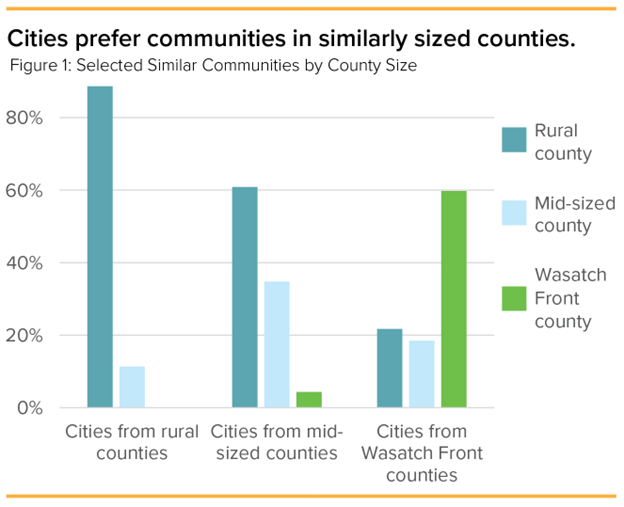
Please note: Wasatch Front counties are Ogden, Davis, Salt Lake, and Utah.


To put it more succinctly, when city officials were asked to identify similar communities on a map, they sometimes chose communities smaller than their own, but rarely chose communities larger than their own.

Keep an eye out for three more posts looking at “Local Government Perspectives.”


About the Survey

The Utah Foundation sought to gain a deeper understanding of how local elected officials viewed the redistricting process. We sent out a survey to elected municipal officials (mayors and city council members). This survey was conducted by University of Utah students in collaboration with the Utah Foundation.  There are about 250 cities, and more than 700 mayors and city council members. We received 96 respondents. The survey ran from October 23, 2020, to November 12, 2020.


What is Redistricting?

Redistricting is a process in which the government or a commission subdivides an area into different districts that will vote for their representative. Often, this focus is on state-drawn districts for members of the U.S. House of Representatives, but it also applies to state legislatures and state school board districts.

There are several general principles to consider in redistricting. One of the most important things is that each district has the same number of people. Contiguity (where all the parts of a district are connected) and compactness (tighter districts are generally considered better than sprawling ones) are also important considerations. There are several additional priorities, including preserving communities of interest, maintaining geographical or man-made boundaries, keeping the core of prior districts, minimizing the division of municipalities and counties, ensuring that boundaries align at different political levels, and prohibiting the purposeful favoring or disfavoring of a party, incumbent, or candidate.

Choosing District Partners

In 2020, the Utah Foundation surveyed city officials to understand how they view their communities. Before asking about redistricting, the survey first asked city officials to identify which communities were similar to their own (see post: Redistricting and Similar Communities). The Utah Foundation then asked specifically about redistricting, whether there was a county that officials preferred to have in their district or a country they preferred to NOT have in their district. Generally speaking, city officials preferred district partners that were in counties similar to their own. More specifically, officials from cities in small and mid-sized counties wanted to be partnered with other small and mid-sized counties, not a county located along the Wasatch Front, which are Weber, Davis, Salt Lake, and Utah counties. Officials from Wasatch Front counties tended to prefer communities located in Wasatch Front counties.  
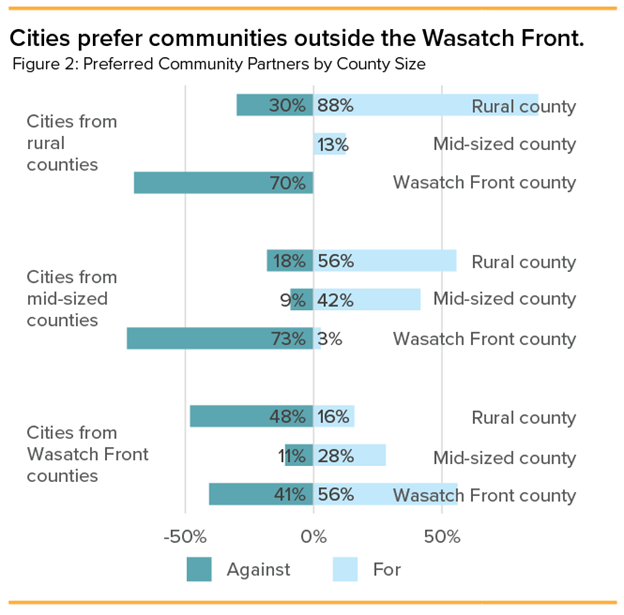
Please note: Wasatch Front counties are Ogden, Davis, Salt Lake, and Utah.


One additional tidbit: When a city official selected a disfavored county on the Wasatch Front, 70% of the time it was Salt Lake County. Even two city officials inside Salt Lake County reported Salt Lake County as a disfavored district partner.

In the end, smaller Utah communities do not want to be in the same district as a Wasatch Front county – especially not Salt Lake County.  

Keep an eye out for three more posts looking at “Local Government Perspectives.”


About the Survey

The Utah Foundation sought to gain a deeper understanding of how local elected officials viewed the redistricting process. We sent out a survey to elected municipal officials (mayors and city council members). This survey was conducted by University of Utah students in collaboration with the Utah Foundation.  There are about 250 cities, and more than 700 mayors and city council members. We received 96 respondents. The survey ran from October 23, 2020, to November 12, 2020.  


What is Redistricting?

Redistricting is a process in which the government or a commission subdivides an area into different districts that will vote for their representative. Often, this focus is on state-drawn districts for members of the U.S. House of Representatives, but it also applies to state legislatures and state school board districts. There are several general principles to consider in redistricting. One of the most important things is that each district has the same number of people. Contiguity (where all the parts of a district are connected) and compactness (tighter districts are generally considered better than sprawling ones) are also important considerations. There are several additional priorities, including preserving communities of interest, maintaining geographical or man-made boundaries, keeping the core of prior districts, minimizing the division of municipalities and counties, ensuring that boundaries align at different political levels, and prohibiting the purposeful favoring or disfavoring of a party, incumbent, or candidate.

City and Town Officials’ Priorities

When redistricting, the Utah Legislature outlined several guiding principles. These include:

  • Preserving communities of interest
  • Preserving geographical or man-made boundaries
  • Preserving the core of prior districts
  • Minimizing the division of municipalities and counties
  • Maximizing boundary agreement at different political levels
  • Prohibiting the purposeful favoring or disfavoring of a party, incumbent, or candidate

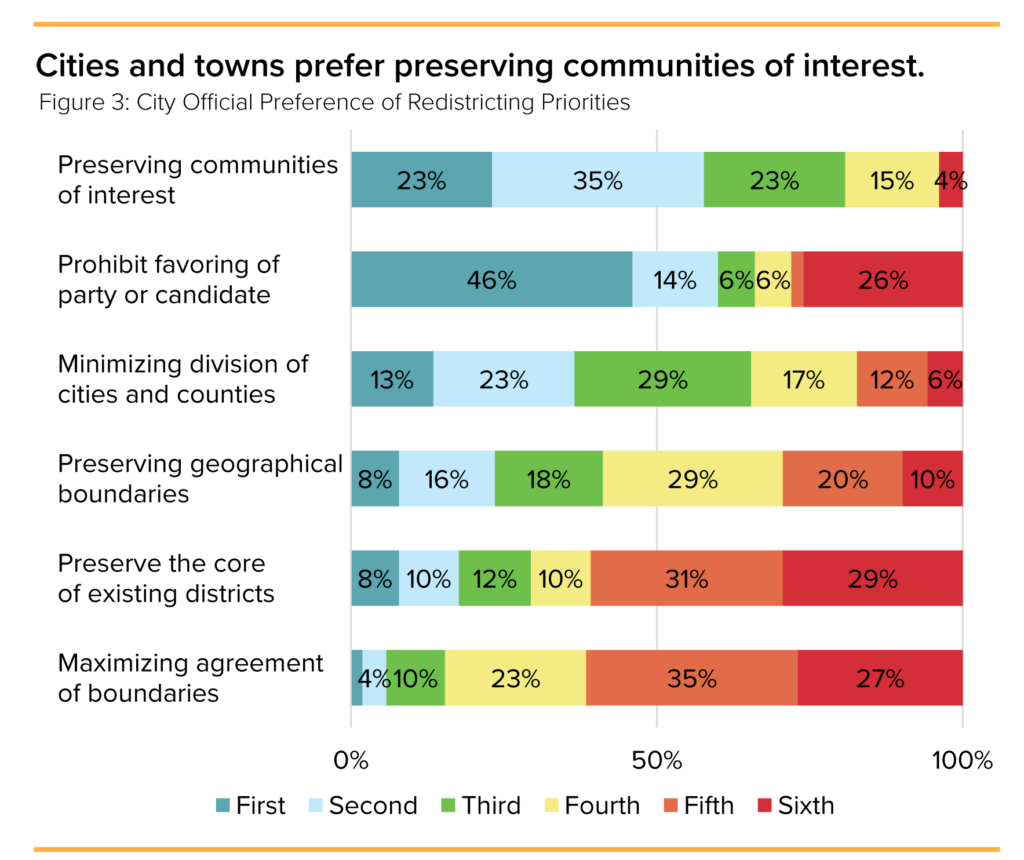
In 2020, the Utah Foundation conducted a survey of city officials to gain insight into their perspectives on the redistricting process. Officials were asked to prioritize the six principles, from most important to least important.  

Preserving communities of interest and avoiding partisan gerrymanders were most important for city officials. Keeping geographical and man-made boundaries, such as cities and counties, was of secondary importance. Keeping the existing core of districts and maximizing boundary agreement were the least important items.
 

Keep an eye out for three more posts looking at “Local Government Perspectives.”  


About the Survey

The Utah Foundation sought to gain a deeper understanding of how local elected officials viewed the redistricting process. We sent out a survey to elected municipal officials (mayors and city council members). This survey was conducted by University of Utah students in collaboration with the Utah Foundation.  There are about 250 cities, and more than 700 mayors and city council members. We received 96 respondents. The survey ran from October 23, 2020, to November 12, 2020.


What is Redistricting?

Redistricting is a process in which the government or a commission subdivides an area into different districts that will vote for their representative. Often, this focus is on state-drawn districts for members of the U.S. House of Representatives, but it also applies to state legislatures and state school board districts. There are several general principles to consider in redistricting. One of the most important things is that each district has the same number of people. Contiguity (where all the parts of a district are connected) and compactness (tighter districts are generally considered better than sprawling ones) are also important considerations. There are several additional priorities, including preserving communities of interest, maintaining geographical or man-made boundaries, keeping the core of prior districts, minimizing the division of municipalities and counties, ensuring that boundaries align at different political levels, and prohibiting the purposeful favoring or disfavoring of a party, incumbent, or candidate.

Preferred Maps

In 2020, the Utah Foundation conducted a survey of city officials to gain insight into their perspectives on redistricting. One question offered a small sample of maps to choose from, asking respondents which redistricting option would most benefit their community. The urban/rural map was most popular, although nearly a quarter of respondents were satisfied with the status quo.  (See Figure 1.)
 

Question: “If the current congressional district boundaries were to be redrawn, which of the following options would most benefit the community you represent?”


A Utah court required the Legislature to redraw its congressional districts. The Legislature finalized its choice, though Better Boundaries quickly responded with a lawsuit and two maps of their own. (See Figure 2.)  
 

The court maps are from the Better Utah Institute, “Congressional Map Scores and Analysis,” https://betterutahinstitute.org/maps-report/.


Ultimately, there are numerous ways to draw maps. You can try your own hand at map drawing, here.

See the three other posts looking at “Local Government Perspectives” on the Utah Foundation’s Redistricting in Utah page.


About the Survey

The Utah Foundation sought to gain a deeper understanding of how local elected officials viewed the redistricting process. We sent out a survey to elected municipal officials (mayors and city council members). This survey was conducted by University of Utah students in collaboration with the Utah Foundation.  There are about 250 cities, and more than 700 mayors and city council members. We received 96 respondents. The survey ran from October 23, 2020, to November 12, 2020.


What is Redistricting?

Redistricting is a process in which the government or a commission subdivides an area into different districts that will vote for their representative. Often, this focus is on state-drawn districts for members of the U.S. House of Representatives, but it also applies to state legislatures and state school board districts. There are several general principles to consider in redistricting. One of the most important things is that each district has the same number of people. Contiguity (where all the parts of a district are connected) and compactness (tighter districts are generally considered better than sprawling ones) are also important considerations. There are several additional priorities, including preserving communities of interest, maintaining geographical or man-made boundaries, keeping the core of prior districts, minimizing the division of municipalities and counties, ensuring that boundaries align at different political levels, and prohibiting the purposeful favoring or disfavoring of a party, incumbent, or candidate.

Comments are closed.