

The Finding
Of the 14 research reports released in 2025, there were a lot of key findings. The Utah Foundation’s Board of Directors selected the top 10. In 6th place:
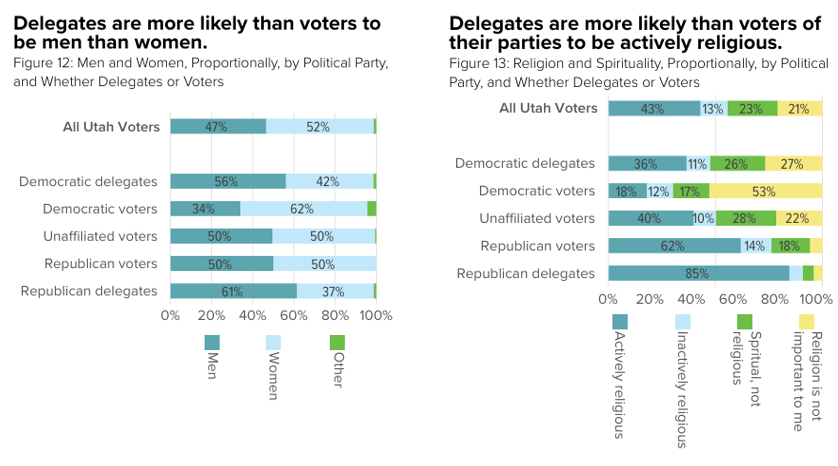
“Both Republican and Democratic delegates are more likely than voters to be men, actively religious, older, and white, and have more education and higher incomes.”
The Details
The Utah political process includes the use of party delegates. Delegates are representatives chosen at a party caucus to represent voters. These delegates then choose party candidates at political party conventions.
A 2025 report, Partisan Lines: Where Utah’s Delegates and Voters Align and Diverge, details party delegates’ survey responses to the 2024 Utah Priorities Project. By comparing responses to those of Utah voters, the reports seek to understand how voters and delegates are similar and different across a wide range of topics that affect all Utahns.
The report found that delegates from both parties are more pessimistic than their voter counterparts, noting that Utah is on the wrong track and that their quality of life has decreased. It found that Utah’s Republican delegates are somewhat more conservative than Republican voters, while Democratic delegates are about the same as Democratic voters. And it found that Republican delegates place less importance on housing, roads, air quality, and crime when compared to Republican voters, while Democratic delegates focus more on education content and less on healthcare and homelessness when compared to Democratic voters.
However, the finding that made it to the top of the list was the demographic differences.
The Background
Read more about this finding in its full report here.
And here is the full 2024 Utah Priorities Project series.
Coming Up
Learn about the other nine top findings from 2025 in our Significant Statistics blog posts.
Categories: