

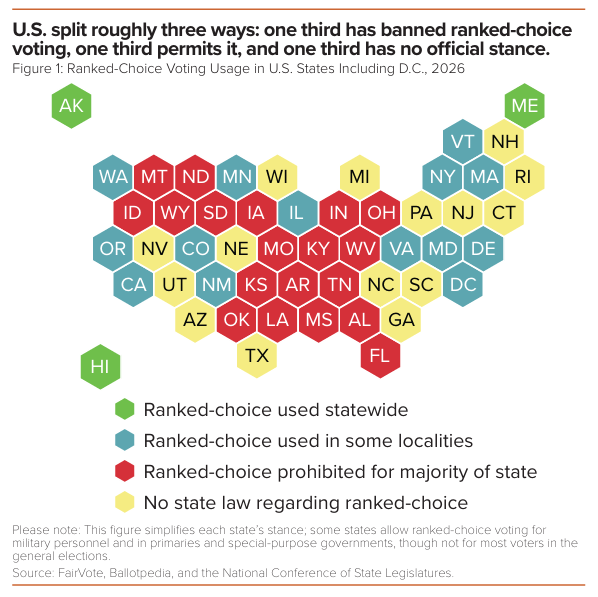
The Utah State Legislature authorized a pilot program allowing municipalities to use a ranked-choice process for municipal elections. That program sunsetted as of 2026.
Is ranked-choice voting in Utah dead? At least for now.
Nonetheless, A Tale of Two Ballots examines ranked-choice voting by comparing it with the typical simple-plurality voting. Ranked-choice voting has strengths and weaknesses, but less evidence supports its impact on election quality.
RCV strengths:
- It allows voters to communicate more information than simple-plurality voting.
- It ensures that the elected candidate will win a majority of the non-exhausted ballots.
- It can save on administrative costs when used to combine multiple elections.
RCV weaknesses:
- Complexity.
- Slower unofficial results when there is no majority winner outright.
- Unfamiliar.
Possible RCV strengths related to quality of elections:
- More civility and coordination between candidates.
- Allows for more competitive elections.
- Results in higher voter turnout.
- More likely to elect the “right” candidate.
Read A Tale of Two Ballots: Comparing Ranked-Choice and Simple-Plurality Voting in Utah for more information.